Responsibility
And emotions...

I am working on the series about Christopher Scholtes, and his daughter’s death in his car, and something occurred to me. That is, why do so many neurotypicals struggle with taking responsibility, and why it may be that psychopaths do as well.
If you think about the notion of responsibility, it is rather transactional. You do X and Y results. You may not intend for Y, but you could have reasonably foreseen Y as a consequence. This is an excellent example of cause and effect, and should be a straightforward thing to understand, and yet, it is something that people have fought with for the entirety of human history, it seems. In our current time, there seems to be a concerted effort to remove any sort of attachment to responsibility, and when that happens, you get D-bags like Christopher Scholtes.
I was telling my Significant Other about this case, and we were discussing responsibility. I have been rereading the Little House on the Prairie books, which are such great books, and there is a scene in one of them. No, you don’t have to know the books to understand this, but I will explain just a little bit of what they are about.
The books were written by Laura Ingalls Wilder about her life as a pioneer in the eighteen hundreds. She, along with her family, her mother, father, sister Mary, sister Carrie, and later on, baby Grace, crossed the Great Plains in a covered wagon, and settled in many different places, but their final place, where they built their forever house (not Laura’s, as she keeps moving later in her life), is in the Dakotas. In the part that comes to mind, her father, Pa, is mowing hay for the winter, and his mower breaks a tooth. He needs to replace it, but he doesn’t want to leave his work in order to make the walk to town to get a new part. Town is about a mile and a half away, and he asks Laura to go and get the mower tooth.
Laura grew up crisscrossing prairies, not around a lot of people. She hated being in town, or going to town, because it frightened her, but she knew that Pa needed this part, and she also knew not to complain. Complaining was not well looked upon. She goes to the house, tells her mother, Ma, that she has to go to town. Her younger sister Carrie offers to go with her, and gets permission from Ma to do so. She hopes that her mother will let her wear her hair ribbons, usually reserved for church, and also her sister Mary’s sunbonnet. The books are written from Laura’s third-person perspective, and the passage reads:
Quickly they changed to fresh dresses and put on their stockings and shoes. But Ma saw no reason for hair ribbons on a weekday, and said that Laura must wear her own bonnet.
“It would be fresher,” said Ma, “if you took care to keep it so.” Laura’s bonnet was limp from hanging down her back, and the strings were limp too. But that was Laura’s own fault.
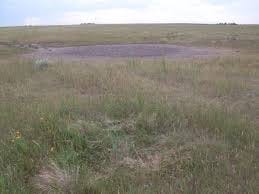
Laura knew she was responsible, and had no one but herself to blame. Later on in the same chapter, after they have made the trip to town, and purchased the mower part, they are walking back. Her sister Carrie, who is ten in this part of the books, suggests walking through the slough to get back to Pa faster. For those of you unfamiliar with a slough, pronounced, sloo, this is what one, actually the exact one I am telling you about, looks like:
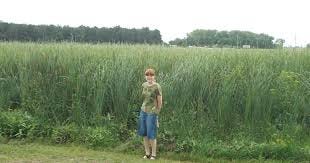
That image shows how tall the prairie grasses get, and here is how thick they can be:
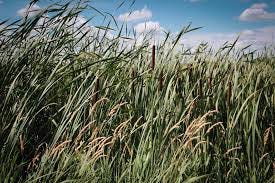
It would be like walking into a cornfield, without the rows, which would make movement easier. They wouldn’t have been able to cross the slough at any other time, as it is normally bogged down with water, and has many marshy spots where you would just sink in, but it was a very hot time of year, which meant that the slough water had dried up, leaving behind tall grasses that are basically impossible to navigate. The big slough, the one that they decided to cross, is, indeed, big:
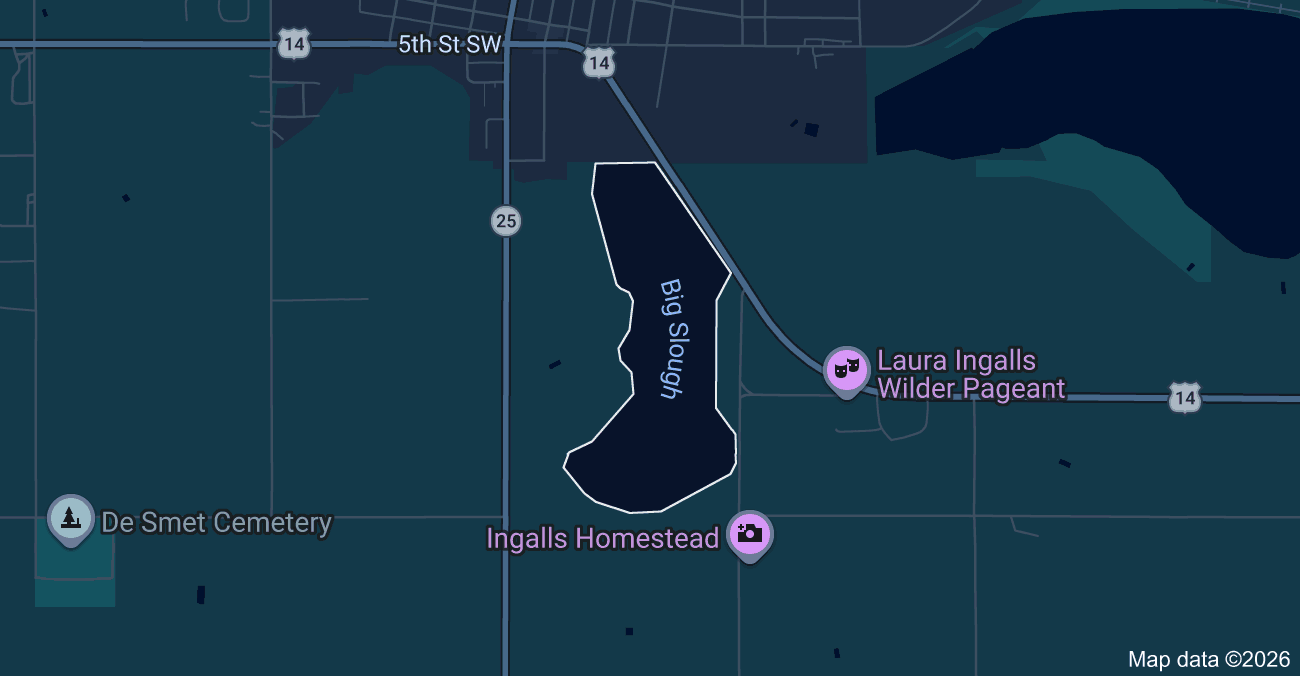
You can see on the map where the homestead was, and where the town was, so in their minds, or Carrie’s rather, cutting straight across would be faster than going around. Laura agrees to this plan, and they wade into those grasses, only to discover after a bit of hard going, they had no idea where they were. They couldn’t see anything to navigate, and they could just be going around and around in circles. They would have no way of being certain.
At first, it was fun. It was rather like going into the jungle-picture in Pa’s big green book. Laura pushed ahead between the thick clumps of grass-stems, that gave way, rustling, and closed again behind Carrie. The millions of coarse grass-stems and their slender, long leaves were greeny gold and golden green in their own shade. The earth was crackled with dryness underfoot, but a faint smell of damp lay under the hot smell of the grass. Just above Laura’s head the grass-tips swished in the wind, but down at their roots was a stillness, broken only where Laura and Carrie went wading through it.
“Where’s Pa?” Asked Carrie suddenly.
Laura looked around her. Carrie’s peaked little face was pale in the shade of the grass. Her eyes were almost frightened.
“Well, we can’t see him from here,” Laura said. They could only see the leaves of the thick grass waving, and the hot sky overhead. “He’s right in front of us. We’ll come to him in a minute.”
She said it confidently, but how could she know where pa was? She could not even be sure where she was taking Carrie. The smothering heat made sweat trickle down her throat and her backbone, but she felt cold inside. She remembered the children near Brookings, lost in the prairie grass. The slough was worse than the prairie. Ma was always afraid that Grace would be lost in this slough.
She listened for the whirr of the mowing machine, but the sound of grasses filled her ears. There was nothing in the flickering shadows of their thin leaves blowing and tossing higher than her eyes, to tell her where the sun was. The grasses bending and swaying did not even tell the direction of the wind. Those clumps of grass would hold up to no weight at all. There was nothing, nothing anywhere that she could climb to look out above them, to see beyond them, and know where she was.
“Come along, Carrie,” she said cheerfully. She must not frighten Carrie. Carrie followed trustfully, but Laura did not know where she was going. She could not even be sure that she was walking straight. Always a clump of grass was in her way; she must go right or left. Even if she went to the right of one clump of grass and to the left of the next clump, that did not mean that she was not going in a circle. Lost people go in circles and many of them never find their way home.
The slough went on for a mile or more of bending, swaying grasses, too tall to see beyond, too yielding to climb. It was wide. Unless Laura walked straight ahead they might never get out of it.
“We’ve gone so far, Laura,” Carrie panted. “Why don’t we come to Pa?”
“He ought to be around here somewhere,” Laura answered. She could not follow their own trail back to the safe road. Their shoes left almost no tracks on the heat baked mud, and the grasses, the endless swaying grasses with their low leaves hanging dried and broken, were all alike.
Carrie’s mouth opened a little. Her big eyes looked up at Laura, and they said, “I know. We’re lost.” Her mouth shut without a word. If they were lost, they were lost. There was nothing to say about it.
“We’d better go on,” Laura said.
“I guess so. As long as we can,” Carrie agreed.
They went on. They must surely have passed the place where Pa was mowing. But Laura could not be sure of anything. Perhaps if they thought they turned back, they would really be going further away. They could only go on. Now and then they stopped and wiped their sweating faces. They were terribly thirsty but there was no water. They were very tired from pushing through the grasses. Not one single push seemed hard, but going on was harder than trampling hay. Carrie’s thin little face was gray-white, she was so tired.
They continue on for a while longer, until they run across two men doing work on the edge of the slough, and they are able to get out, get directions from them, and get home. On their way home, this conversation is had:
“Were you scared, Laura?” Carrie asked.
“Well, some, but all’s well that ends well,” Laura said.
“It was my fault. I wanted to go that way,” said Carrie.
“It was my fault because I’m older,” Laura said. “But we’ve learned a lesson. I guess we’ll stay on the road after this.”
“Are you going to tell Ma and Pa?” Carrie timidly asked.
“We’ll have to if they ask us,” Laura said.
I conveyed to you that whole story for a point. When you read the narrative, which was written years after the event, you can see that the fear involved was still very alive and present for Laura. She could recall a lot of detail about how suffocating the slough was, disoriented she felt, the physical, but also emotional toll the entire thing took on her and her sister. She could relay this because it was a highly emotionally impactful event, and at the end, both sisters sought to take responsibility for the decisions made.
It was Carrie’s fault. She wanted to go that way. In Carrie’s mind, she made the suggestion, she should be the one held to account. It was Laura’s fault, because she was older, and in being older, her sister’s safety was in her hands. She was the one who decided to agree, and she should have known better. In the context provided, you can see that, indeed, she did know better. She knew about children that became lost in the prairie, and that the slough was worse.
In the previous book, there is a part where baby Grace goes missing when she is out of sight for a few seconds. On that occasion, Laura discovered that the prairie is not flat, as it appears to the eye. It is full of swells and dips that cannot be seen, but the real danger was that she had gone into the slough. Had that been the case, there likely would have been no recovery of her. Sound on the prairie can be muffled and lost, so hearing her cry out was not remotely guaranteed. Fortunately, Laura found her sitting in a buffalo wallow that had been grown over with violets like this one:
Laura was well familiar with the dangers of the slough and chose to go along with Carrie’s suggestion. Carrie was younger, and less inclined to understand that danger as well as Laura did, but they were both responsible, and willing to say as much.
The reason that I bring this story to your attention is the willingness to take ownership despite how negative the emotions of the event were. What I have noticed is that people tend to avoid responsibility due to a myriad of emotional reasons. Many times it is fear of something, but that isn’t always the case. Oftentimes the reasons that I see are:
Not wanting to be singled out, and possibly excised from the group. This one makes sense to me, as this would qualify for death in our evolutionary development. If you were removed from the group, chances are you would be quickly dead.
Fear of judgment and disappointing others. This is also about group survival.
Wanting to avoid negative consequences. This one is where psychopaths land, but there will be a bit more that I will explore with the psychopathic aspects in a moment. Psychopaths don’t want to deal with negative consequences. That’s not fun. We would rather do what we want, and then dodge responsibility later on if we have to do so. This is more of a convenience thing for us. It isn’t that consequences are dreadful, frightening, or unbearable, it’s that they are mildly disruptive to our lives, and mild disruption isn’t interesting to us.
With neurotypicals, the avoidance of negative consequences seems to be pretty strong with a lot of people. I have seen people burn their lives to ashes because they are so emotionally unable to deal with being responsible for things that they did. As I mentioned, psychopaths don’t really want to be inconvenienced with consequences, but we aren’t going to go to the extent of destroying everything else around us to avoid them. If we are caught, and there is no real way to get out of it, the response is, shrug, yeah, I did that. Now what?
That is not what I see in neurotypicals. I have seen, and often I might add, a full-grown adult look at evidence in front of them, and throw a toddler tantrum to get people to stop “being mean” to them, when all that’s happening is they are getting called out on the bullsh*t. Seriously? It’s… a lot, and it can stop now. The need to avoid what is clearly their mess is kind of amazing to watch. I really don’t know where they get the energy.
Now that I have laid the groundwork, in the next post we will be going through the relationship between emotions, responsibility, and why these two things are not the same. Why they should never have been considered the same, either. That was a grave mistake in my estimation. On to, next week.
On a side note, my spell check has this annoying habit of giving up when it thinks the text is too long, but mind you, only on Substack does it do this. If I copy and paste my posts into a word-processing program like Word, or something of the sort, all of a sudden it’s fine and can do the whole thing, so arbitrary length is arbitrary, apparently. Well, now the app has decided that they are going to be taking the free version away, and you have to pay for premium, and I’m like… that ain’t happening buddy, but I have noticed something. Now, it can do much longer documents, and it makes way more suggestions. It’s like it is trying to sell me on the “better version,” but from what I have seen, the “better version” is a pushy, annoying suggestion pusher of all things that make writing boring and bland. It makes suggestions that totally change the context of what I am writing, changes my wording to something that has no draw to it, tries to change wording and format to things that literally make no sense. Such as, it wants to throw a capital letter onto a word in the middle of a sentence. Imagine something Like this. Why would that be capitalized? It wouldn’t be, but the suggestions suddenly think it should be.
According to the new suggestions, the post you’re reading should look more like this:
This is Why I cannot suggest that you. Use this spell—checking program. It Has very little Understanding of how— to write anything;
…They are not doing a very good job of upselling their product. If that is what the “unlocked” and “premium” version is like, good god, no.
Another example. My sentence up above, …They are not doing a very good job of upselling their product.
“doing a very good job” change suggestions:
doing an impressive job
doing a fantastic job
doing an outstanding job
achieving impressive results
achieving fantastic results
No. No to all of it. I wanted to write what I wrote, and I do not want to sound like someone’s boring ass resume. Thank you, spellchecker, for demonstrating why paying for your garbage product would be a massive waste of my money. It has never made suggestions like this, and the only reason it is now, is because the devs think it makes their product look good. Nope, and wrong.
Its only by owning your actions that you have any chance of changing things. By denying your responsibility you deny your agency. An exception would be if I were intentionally hiding something, but if I were caught red-handed, I'd own it. Again, ironically, judging psychopaths as 'bad' because they have less emotional capacity is assuming that having emotional capacity always leads to 'good' choices—in my experience as an ND therapist (ADHD) with a close friend with psychopathy, it is easy to see how that is simply not true. Emotions can make us choose unwisely to avoid emotional discomfort.
Owning your own actions is actually a great deal of fun. I know that at one time I would try to avoid consequences, but it seems like such a hassle to try to keep your story straight. I found that looking them straight in the eye and admitting yes, I did that is quick and easy. However, people are not used to that and frequently want to argue with you at this point the consequences melt away as the person who should be holding you accountable is trying to figure out what you’re doing to try to avoid accountability. I’m not sure if that made any sense, but I found it to be highly amusing.